 Permito
Driving test vocabulary in English and Spanish
On this page
- How we chose the words
- Which words appear most
- Right of way and turns
- Signs and signals
- Lanes and road markings
- Speed and following distance
- Parking
- Alcohol, drugs and distraction
- Licensing and graduated licenses
- Emergencies and equipment
- Spanish words that differ between sources
- How to study these words in two languages
- The bottom line
How we chose the words
Most permit test questions are hard because one word is unfamiliar, not because the rule is hard. “Yield”, “right-of-way”, “shoulder” and “median” are everyday words for a driver and strange ones for a new English learner. This glossary lists such words by topic, each with the Spanish term and a plain meaning.
It extends the short word list in our Florida guide and is built to print or share; ESL teachers and libraries are welcome to link it. More guides: All permit test guides.
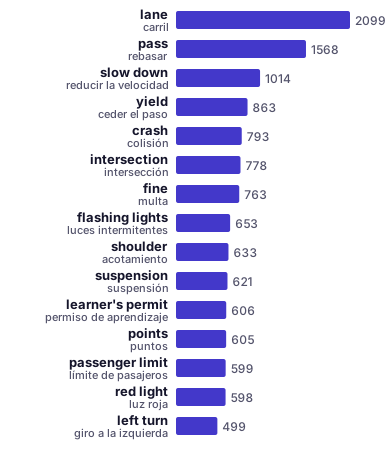
The words come from our own question bank. We counted how many of our more than eleven thousand questions use each candidate word in English (question, options and explanation) and kept the common ones, plus a few rarer ones that matter for safety or that a manual or law defines. Rows run from most to least common. The Spanish column is the Spanish our verified Spanish questions use most often for that word; where California or Virginia publishes a different Spanish word, the section on Spanish words that differ says so.
Meanings follow the sign manual (the MUTCD)1, the Florida and Virginia traffic laws67 and the California and Virginia driver manuals24. A row with no source mark is an ordinary word with its dictionary meaning.
Which words appear most
These fifteen words appear in the most questions. Learn them first.
Right of way and turns
These words decide who goes first. Stop and yield signs are in our Regulatory signs; question counts are in the Questions and pass mark by state, with sources, and how many you may miss is in questions you can miss.
| English on the test | Spanish | What it means |
|---|---|---|
| pass | rebasar | Go past a vehicle that is moving ahead of you in the same direction. |
| yield | ceder el paso | Slow down or stop to let other traffic or people go first. |
| intersection | intersección | The area where two roads meet or cross.6 |
| left turn | giro a la izquierda | Turning from your lane onto a road on the left. Turning left usually means yielding to oncoming traffic. |
| pedestrian | peatón | A person on foot.6 |
| crosswalk | cruce peatonal | The part of the road, at an intersection or marked with lines, where people on foot cross.6 |
| oncoming traffic | tránsito que viene de frente | Vehicles coming toward you from the opposite direction. |
| school bus | autobús escolar | A bus used to carry students to and from school.6 |
| railroad crossing | cruce de ferrocarril | The place where a road crosses train tracks. |
| right-of-way | derecho de paso | The right to go first. When two drivers or pedestrians could collide, the law says who must let the other go ahead.6 |
| merge | incorporarse | Join a lane of moving traffic, for example from an on-ramp. |
| U-turn | vuelta en U | A turn that sends you back the way you came. |
| roundabout | rotonda | A circular intersection where traffic moves one way around a central island.2 |
| turn on red | girar a la derecha con luz roja | Turning right at a red light after you stop, where the law and the signs allow it.2 |
| turn signal | luz direccional | The blinking light that shows you are about to turn or change lanes. |
| flagger | abanderado | A worker who directs traffic with a flag or sign, usually in a work zone. |
| four-way stop | alto en las cuatro direcciones | An intersection where traffic from every direction must stop. Go in the order you arrive. |
| hand signal | señal con la mano | A signal made with your arm to show a turn, a slowdown or a stop.2 |
| uncontrolled intersection | intersección sin control | An intersection with no signs or signals to say who goes first.2 |
Signs and signals
Sign shapes and colors are tested as well as names. See our Road signs: every sign with its name and meaning (Regulatory signs, Warning signs, School signs, Work zone signs, Railroad signs, Guide and service signs), Road sign shapes and colors: what each one means and Do you have to get every road sign question right on the permit test?.
| English on the test | Spanish | What it means |
|---|---|---|
| flashing lights | luces intermitentes | Lights that blink on and off. A flashing red light is treated like a stop sign.2 |
| red light | luz roja | A steady red light means stop. You may turn right after stopping unless a sign bans it.2 |
| stop sign | señal de alto | A red eight-sided sign: come to a full stop.1 |
| diamond | rombo | A square turned on a corner. It is the shape of most warning signs.1 |
| yellow light | luz amarilla | The light is about to turn red. Slow down and stop if you can do it safely.2 |
| work zone | zona de obras | A stretch of road where workers are building or repairing the road.6 |
| traffic signal | semáforo | The red, yellow and green lights that control traffic at an intersection. |
| yield sign | señal de ceder el paso | A sign shaped like a triangle pointing down: let others go first.1 |
| green arrow | flecha verde | An arrow signal that lets you move only in the direction the arrow points.2 |
| do not enter | no entre | A sign that bans entering a road from that direction. Entering would put you going the wrong way.1 |
| warning sign | señal de advertencia | A sign that warns of a hazard or a change ahead. Most are yellow and diamond-shaped.1 |
| octagon | octágono | A shape with eight sides. Only the stop sign has it.1 |
| pentagon | pentágono | A shape with five sides. The school warning sign uses it.1 |
| guide sign | señal de guía | A sign that gives directions, distances or places. Most have a green background.1 |
| regulatory sign | señal reglamentaria | A sign that tells you a rule or law, such as a speed limit or a turn ban.1 |
Sign names in English and Spanish
Sign names from our sign data, in the Spanish our pages use, with the meaning shown in the app. All are signs of the federal sign manual1.
| English on the test | Spanish | What it means |
|---|---|---|
| Do Not Pass | Prohibido rebasar | Drivers may not pass other vehicles in this zone. |
| Pass With Care | Rebase con precaución | The no-passing zone has ended. Drivers may pass if it is safe. |
| No Turn on Red | Prohibido girar con luz roja | Drivers may not turn on a red light at this place, even if turns on red are normally allowed. |
| Road Closed | Camino cerrado | The road is closed to all traffic. |
| Railroad Crossing (Crossbuck) | Cruce de ferrocarril (cruz de San Andrés) | The road crosses railroad tracks. Drivers must give way to trains. |
| Stop Ahead | Alto más adelante | A stop sign is coming up that you may not see in time. |
| Slippery When Wet | Resbaladizo cuando está mojado | The road becomes slippery when it is wet. |
| Merge | Incorporación por la derecha | A lane from the right joins your road ahead. |
| Pedestrian Crossing | Cruce peatonal | Pedestrians may cross the road ahead. |
| Road Work Ahead | Obras en el camino adelante | A work zone is ahead, with workers and equipment near the road. |
Lanes and road markings
A state may name the same marking differently; check your handbook via the Permit test by state, for example the Washington guide or the Ohio guide.
| English on the test | Spanish | What it means |
|---|---|---|
| lane | carril | The part of the road for one line of vehicles.7 |
| shoulder | acotamiento | The part of the road beside the lanes, between them and the curb or ditch.7 |
| freeway | autopista | A major road for fast through traffic, with ramps for entering and leaving. |
| broken line | línea discontinua | A line made of dashes. You may cross it to pass or change lanes when it is safe. |
| solid line | línea continua | An unbroken line. Do not cross a solid line unless the law allows it. |
| median | mediana | The strip of land or barrier that separates traffic going in opposite directions. |
| center turn lane | carril central de giro | A middle lane that drivers going either way use for left turns. |
| blind spot | punto ciego | The area beside and behind your vehicle that your mirrors do not show.2 |
| no-passing zone | zona de no rebasar | A stretch of road where passing is not allowed.1 |
| stop line | línea de alto | A wide white line across the lane where you must stop.2 |
| double yellow line | doble línea amarilla | Two solid yellow lines in the middle of the road. Do not pass over them.2 |
Speed and following distance
Learn the words here, then the numbers in your state’s guide. A handbook and the law can differ on speed: see the handbook and the law.
| English on the test | Spanish | What it means |
|---|---|---|
| slow down | reducir la velocidad | Lower your speed by easing off the gas or braking. |
| speed limit | límite de velocidad | The fastest speed the law allows on that road. |
| headlights | faros | The lights at the front of your vehicle. Use them at night and when it is hard to see. |
| high beams | luces altas | Headlights at full brightness, for open dark roads. Switch to low beams near other vehicles. |
| following distance | distancia de seguimiento | The space you keep between your vehicle and the one ahead.2 |
| stopping distance | distancia de frenado | How far your vehicle travels while you react and brake until it stops. |
| tailgating | seguir muy de cerca | Following the vehicle ahead too closely.2 |
| basic speed law | ley de velocidad básica | Never drive faster than is safe for the conditions, even if you are under the posted limit.2 |
Parking
Questions ask where you may not park and what to do before you leave the car.
| English on the test | Spanish | What it means |
|---|---|---|
| fire hydrant | hidrante | The street connection firefighters use for water. Do not park close to one. |
| parking brake | freno de estacionamiento | The brake that holds a parked vehicle in place. Set it every time you park.2 |
| no parking | prohibido estacionar | A sign or curb marking that bans parking there. |
Alcohol, drugs and distraction
The terms are the same in every state; the limits are not. See your state guide, for example the California guide.
| English on the test | Spanish | What it means |
|---|---|---|
| DUI | conducir bajo los efectos (DUI) | Driving under the influence: driving after drinking alcohol or using drugs, to the degree the law forbids.2 |
| impaired | bajo los efectos | Not able to drive safely because of alcohol, drugs, medicine or tiredness. |
| chemical test | prueba química | A breath, blood or urine test that measures alcohol or drugs.2 |
| BAC | nivel de alcohol en la sangre (BAC) | Blood alcohol concentration: the share of alcohol in your blood. The law sets limits.2 |
| reckless driving | manejo imprudente | Driving with clear disregard for the safety of others. |
| drowsy driving | manejar con sueño | Driving while very tired or sleepy. Fatigue can affect your vision and slow your reactions.2 |
| open container | envase abierto | An opened container of alcohol in the passenger area of a vehicle.2 |
| distracted driving | conducción distraída | Driving while your attention is on something other than the road. |
| implied consent | consentimiento implícito | By driving, you agree to a chemical test if an officer suspects you of drinking. Refusing can cost you your license.2 |
| hit and run | darse a la fuga | Failing to stop, or leaving the scene of a crash.2 |
| prescription medication | medicamento recetado | Medicine a doctor orders for you. Some kinds can make you an unsafe driver.2 |
| zero tolerance | tolerancia cero | A rule that sets the blood alcohol limit close to zero for drivers under 21.2 |
Licensing and graduated licenses
Graduated licensing (GDL) gives a new driver more freedom in steps; names and hours change by state. See, for example, Texas, New York, Georgia or Florida, and For parents for families.
| English on the test | Spanish | What it means |
|---|---|---|
| fine | multa | Money you must pay as a penalty. |
| suspension | suspensión | Your license is taken away temporarily, and you may get it back later.6 |
| learner’s permit | permiso de aprendizaje | A permit that lets you practice driving with a licensed adult before you get a license. |
| points | puntos | Numbers added to your driving record for violations. Too many can lead to a suspension.2 |
| passenger limit | límite de pasajeros | A cap on how many passengers a young driver may carry, or who they may be. |
| revocation | revocación | Your license is ended. You must apply again, often after a waiting time.6 |
| road test | examen de manejo | The test where you drive while an examiner watches. |
| supervised driving | manejo supervisado | Practice driving with a qualified adult beside you. |
| provisional license | licencia provisional | A license for new drivers with limits, such as no driving late at night. Some states call it intermediate.2 |
| knowledge test | examen de conocimientos | The written or computer test on traffic laws and signs. |
| traffic infraction | infracción de tránsito | Breaking a traffic law in a way that is not a felony or a misdemeanor.7 |
| driver’s license | licencia de conducir | The document that lets you drive on your own.7 |
| graduated licensing | licencia graduada | A system that gives new drivers more freedom in steps, with limits at first. |
| curfew | toque de queda | The late-night hours when a young driver may not drive, with some exceptions.2 |
Emergencies and equipment
Questions ask what to do when something goes wrong and which equipment must work. Try the Texas practice test.
| English on the test | Spanish | What it means |
|---|---|---|
| crash | colisión | When a vehicle hits another vehicle, a person or an object. |
| hazard lights | luces de emergencia | Flashing lights that warn the drivers behind you of a problem.2 |
| move over | moverse a un lado | Change lanes or slow down to give room to stopped emergency vehicles, tow trucks and road work vehicles.2 |
| emergency vehicle | vehículo de emergencia | An ambulance, fire truck or police vehicle using lights or a siren. |
| seat belt | cinturón de seguridad | The belt that holds you in your seat in a crash. |
| brakes fail | fallan los frenos | The brakes stop working when you press the pedal. |
| tire blowout | reventón | A tire that bursts suddenly while you drive. Hold the wheel firmly and do not brake hard.2 |
Spanish words that differ between sources
Spanish differs by region. These are the words where the Spanish of our questions is not the Spanish of every agency. Both are understood; our practice questions use the first, and your state’s Spanish exam may use its agency’s word.
| English | Our questions | Agency Spanish |
|---|---|---|
| driver’s license | licencia de conducir | California’s Spanish manual says “licencia de manejar”3; Virginia’s says “licencia de conducir”5. |
| crash | colisión | The Spanish manuals of California and Virginia say “choque”35. |
| roundabout | rotonda | California’s Spanish manual says “glorieta”3; Virginia’s says “glorieta/rotonda”5. |
| knowledge test | examen de conocimientos | Virginia’s Spanish manual says “examen de conocimientos”5; California’s says “examen teórico”3. |
| learner’s permit | permiso de aprendizaje | Virginia’s Spanish manual says “permiso de aprendizaje”5; California’s says “permiso de instrucción”3. |
| shoulder | acotamiento | California’s Spanish manual writes “acotamiento/arcén”3; Virginia’s says “orilla de la carretera”5. |
| driving under the influence | conducir bajo los efectos del alcohol | California’s Spanish manual says “manejar bajo los efectos del alcohol”3; “manejar” and “conducir” mean the same. |
If your handbook uses another word than the one in your practice questions, they are the same thing. California and Virginia both publish a Spanish handbook, so you can read their rules in the California guide and practice test, or the Virginia guide and practice test, and then compare the handbook and the law with the Virginia handbook and law page.
How to study these words in two languages
The rules do not change with the language you read them in; what changes is how fast you recognize a word.
- Learn one group at a time. Cover the English column and say each term from the Spanish and the meaning, then reverse.
- Read the same manual twice. California and Virginia publish their driver manual in English and Spanish2345.
- Keep your own short list of the words you miss in practice.
- End in English. The test may be English only, as in Florida; finish by reading questions in English without help (see the Florida guide).
In the Permito app every state’s questions are in English and Spanish and you can show both languages side by side; see the languages section of the home page. For free practice before you start, try the Florida practice test.
The bottom line
Learn the words in the order of the tables, which is the order they appear in our questions, and use the Spanish column to check that you understood each meaning before you answer in English. When a word in your handbook differs from the one here, the table of Spanish words that differ tells you why.
Related guides
Keep going
- Regulatory signs
- Warning signs
- Permit test by state
- Questions and pass mark by state, with sources
- All permit test guides
Practice for your state in the app
Permito has a question set for every state and Washington, D.C., mock exams, a road sign trainer and an explanation for every answer. It is free to start and needs no account.
Sources
- Federal Highway Administration (FHWA): Manual on Uniform Traffic Control Devices (MUTCD) (11th Edition with Revision 1 (December 2025)).
- California Department of Motor Vehicles (DMV): California Driver Handbook (2025 edition (DL 600, copyright 2025)).
- California Department of Motor Vehicles (DMV): Manual del automovilista de California (Spanish edition (DL 600 Spanish, REV. 6/2025)).
- Virginia Department of Motor Vehicles: Virginia Driver’s Manual (English edition, PDF file dated April 2026).
- Virginia Department of Motor Vehicles: Manual del Conductor de Virginia (Spanish edition (DMV 39S), PDF file dated April 2026).
- The Florida Legislature: Florida Statutes 316.003, Definitions (2026 Florida Statutes).
- Virginia Legislative Information System: Code of Virginia § 46.2-100, Definitions (web page, read November 14, 2026).
Update history
- : Published. 99 terms chosen by how often they appear in our question bank; meanings checked against the MUTCD, the Florida and Virginia traffic laws and the California and Virginia driver manuals (English and Spanish); Spanish terms checked against our verified Spanish question text.
Rules change. Check your state’s official handbook before your test. Permito is a private study app, not affiliated with any DMV or government agency. Found a mistake? Write to support@permito.app and we will check it against the source. How we check facts.