 Permito
Road sign shapes and colors: what each one means
Key takeaways
- Shape and color are fixed by one national standard, the Manual on Uniform Traffic Control Devices (MUTCD). The current text is the 11th Edition with Revision 1, effective March 5, 2026 (FHWA MUTCD page).
- Some shapes belong to a single sign: the octagon is only for STOP and the downward triangle only for YIELD (MUTCD). Learn those first.
- Color tells you the kind of sign: red means stop or prohibition, yellow means warning, orange means temporary traffic control and green means direction guidance (MUTCD).
- Diamonds and rectangles are families, not single signs. Read the color first, then the shape, then the words or symbol.
On this page
- Which standard sets sign shapes and colors?
- What does each road sign shape mean?
- Which shapes should you learn first?
- Diamonds: one shape, three color families
- Rectangles: regulatory, warning and guide signs
- What does each road sign color mean?
- Which colors go together on each type of sign?
- How do you read a sign you have not seen before?
- Where do shapes and colors show up on the permit test?
- The bottom line
Which standard sets sign shapes and colors?
The MUTCD is the national standard for all traffic control devices on any street, highway or bicycle trail open to public travel (23 CFR 655.603). The Federal Highway Administration (FHWA) publishes it. Its current text is the 11th Edition with Revision 1: the Revision 1 final rule took effect on March 5, 2026, and the FHWA calls the PDF of the 11th Edition with Revision 1 the most current edition (FHWA MUTCD page) (Federal Register rule). The 11th Edition itself took effect on January 18, 2024 (FHWA MUTCD page). Under federal rules, states must adopt changes to the national MUTCD within two years of the effective date of the final rule (23 CFR 655.603).
Three parts of the manual answer this guide’s question. Section 2A.05 and its Table 2A-1 list the sign shapes. Section 2A.06 and its Table 2A-2 show which colors are common on which types of sign. Section 1D.05 gives most colors a general meaning (MUTCD). Virginia’s driver’s manual teaches the same system in plain language and puts it in one sentence: the color and shape of a traffic sign communicate important information about its message (Virginia Driver’s Manual).
Every sign picture in this guide comes from the same federal artwork that fills our Road signs: every sign with its name and meaning page. If your goal is the knowledge test, the separate guide Do you have to get every road sign question right on the permit test? covers which states score signs on their own.
What does each road sign shape mean?
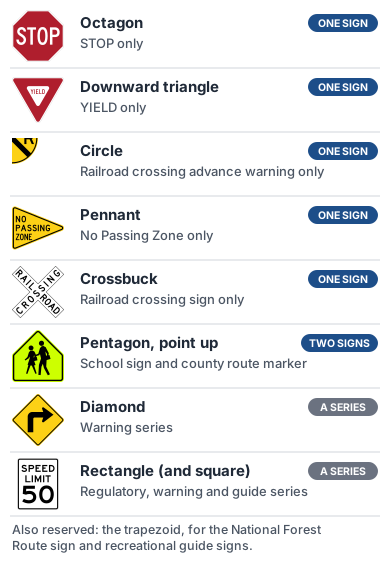
Table 2A-1 says particular shapes shall be used exclusively for specific signs or series of signs, unless the manual provides otherwise (MUTCD). Here is the table in plain words.
- Octagon: the STOP sign (R1-1) and nothing else (MUTCD).
- Downward-pointing triangle: the YIELD sign (R1-2) only (MUTCD).
- Circle: the railroad grade crossing advance warning sign (W10-1) only (MUTCD).
- Pennant (a triangle lying on its side and pointing right): the NO PASSING ZONE sign (W14-3) only (MUTCD).
- Crossbuck (two rectangles crossed in an X): the railroad grade crossing sign (R15-1) only (MUTCD).
- Upward-pointing pentagon: two signs, the school sign (S1-1) with squared bottom corners and the county route marker (M1-6) with tapered lower sides (MUTCD).
- Diamond: the warning series (MUTCD).
- Rectangle (including a square): the regulatory, guide and warning series (MUTCD).
- Trapezoid: the National Forest Route sign (M1-1) and the recreational and cultural interest area guide series (MUTCD).
Our road sign pages sort every sign by group: Regulatory signs, Warning signs, School signs, Work zone signs, Railroad signs and Guide and service signs.
Which shapes should you learn first?
Start with the shapes reserved for one sign: the octagon, the downward triangle, the circle, the pennant and the crossbuck (MUTCD). They are the easiest to learn and the most useful, because a reserved shape points to one sign before you can read a word. Virginia’s manual makes a related point: in poor visibility, such as heavy fog, you may be able to make out only the shape of a sign (Virginia Driver’s Manual). That manual describes the octagon as an eight-sided shape that always means stop (Virginia Driver’s Manual).
The MUTCD also protects these shapes on the road. It says a shape exclusive to a particular sign, such as the octagon for STOP, should not be hidden by another sign mounted on the back of the same assembly (MUTCD). It does not allow changes to standard shapes either, such as cutting off the left and right points of a diamond (MUTCD). So a sign shaped like a stop sign but in another color, or a diamond with its points cut off, is not a standard sign.
The school pentagon deserves a second look, because the shape is shared. The county route marker is also a pentagon, with tapered lower sides, and it is yellow on blue, so the lower corners and the color tell the two apart (MUTCD). Our School signs page shows the school family.
Diamonds: one shape, three color families
Unless the manual specifically says otherwise, all warning signs are diamond-shaped, with a black legend and border on a yellow background (MUTCD). A diamond is therefore a warning, but its color tells you what kind. Signs about pedestrians, bicyclists and playgrounds may be black on yellow or black on fluorescent yellow-green (MUTCD). Temporary traffic control signs are black on orange, and school signs are black on fluorescent yellow-green (MUTCD).
That is why a yellow turn sign, an orange road work sign and a fluorescent yellow-green school bus sign can share a shape and still mean different things: you slow down for the turn, expect workers at the orange one and watch for children at the third. If you are studying for the knowledge test, treat the diamond as “watch out” and let the color narrow it down. Our Warning signs and Work zone signs pages show more of each.
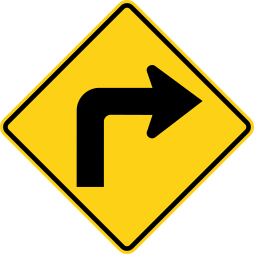 Right Turn (W1-1R)
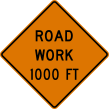 Road Work Ahead (W20-1)
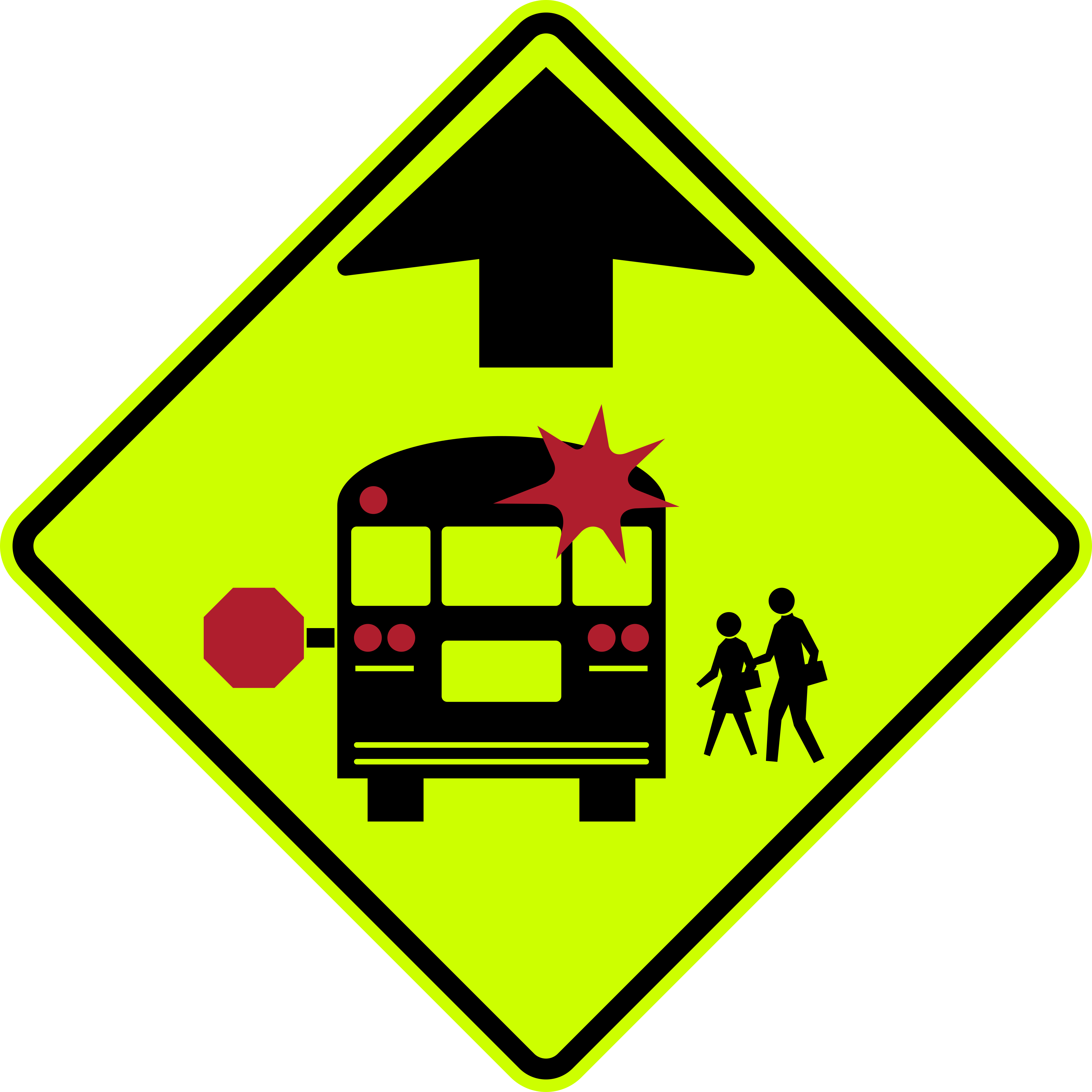 School Bus Stop Ahead (S3-1)
Rectangles: regulatory, warning and guide signs
Regulatory signs are rectangular unless the manual designates otherwise (MUTCD). Table 2A-1 also gives the rectangle to the guide series and to part of the warning series (MUTCD), so a rectangle alone does not tell you what the sign is. A white rectangle with black letters is usually a rule, such as a speed limit. A green rectangle is guidance. A yellow rectangle is still a warning.
The way a rectangle is turned gives a second clue. In Virginia’s manual, vertical rectangles generally give instructions or tell you the law, and horizontal ones may give directions or information (Virginia Driver’s Manual). Guide signs on streets and highways have a white message and border on a green background unless the manual says otherwise (MUTCD). More examples are in the Guide and service signs group.
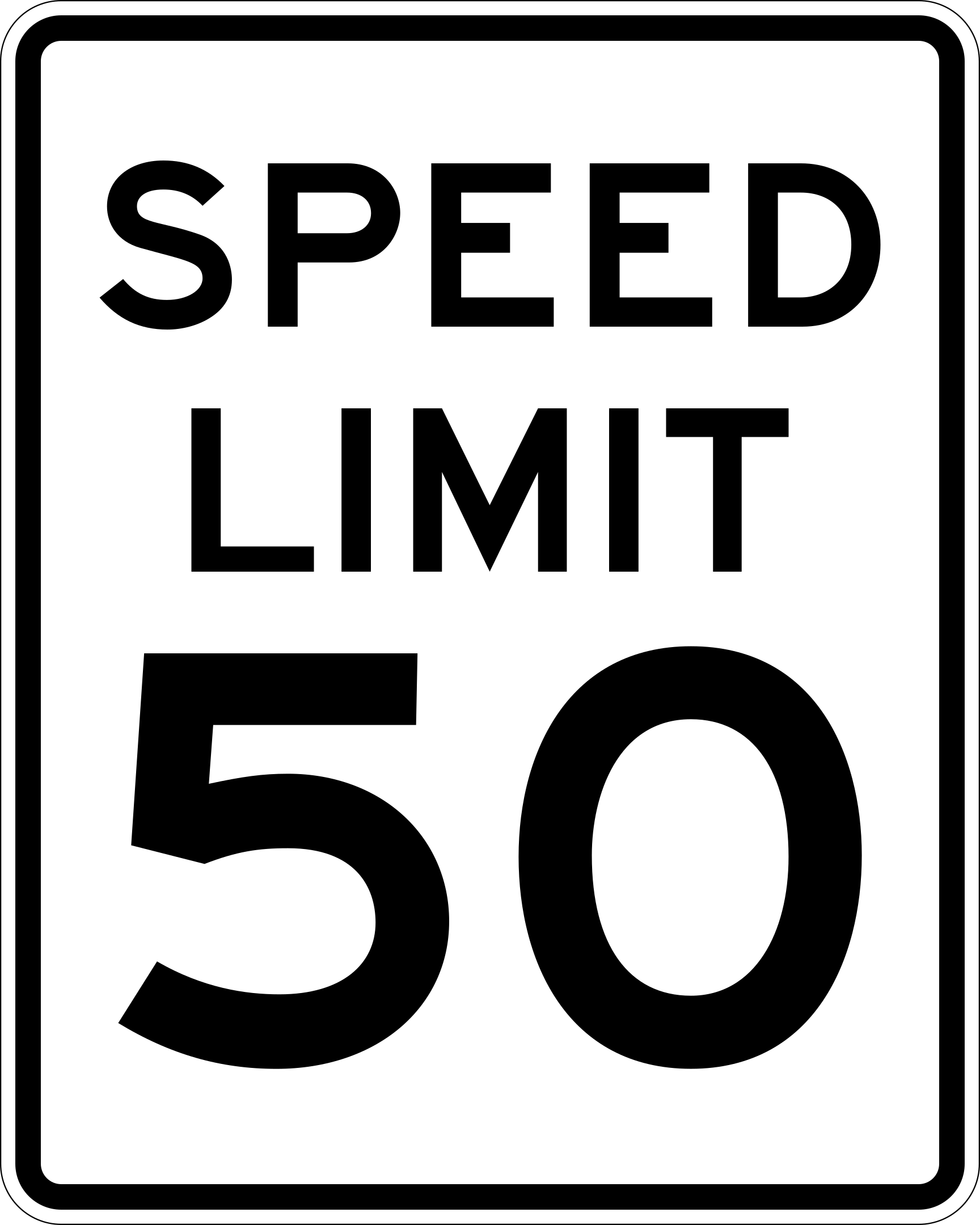 Speed Limit (R2-1)
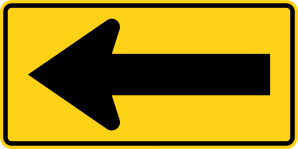 One-Direction Large Arrow (W1-6)
 Street Name (D3-1)
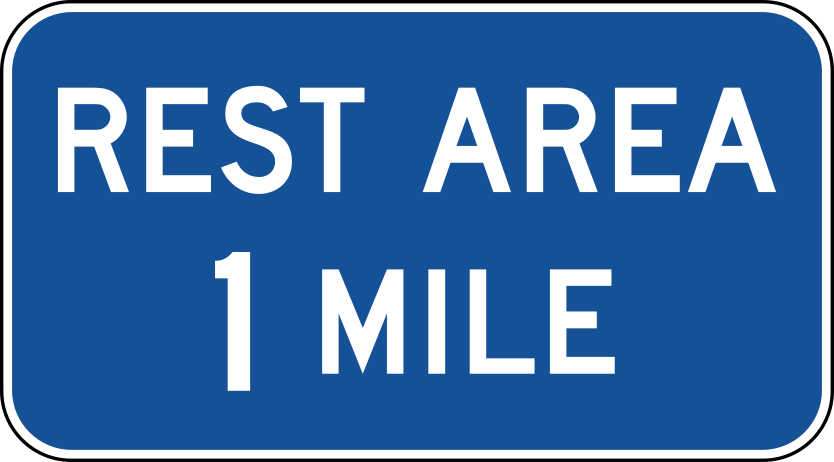 Rest Area (D5-1)
What does each road sign color mean?
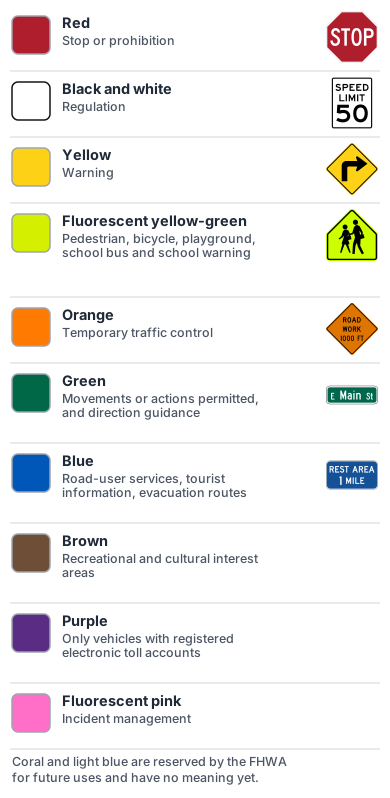
Section 1D.05 sets a general meaning for 11 of the 13 colors identified for traffic control, and the manual says each color shall be used only as prescribed for specific devices (MUTCD). The meanings are:
- Red: stop or prohibition (MUTCD).
- Black and white: regulation (MUTCD).
- Yellow: warning (MUTCD).
- Fluorescent yellow-green: pedestrian, bicycle, playground, school bus and school warning (MUTCD).
- Orange: temporary traffic control (MUTCD).
- Green: permitted movements or actions, and direction guidance (MUTCD).
- Blue: road-user services guidance, tourist information and evacuation routes (MUTCD).
- Brown: recreational and cultural interest area guidance (MUTCD).
- Purple: use only by vehicles with registered electronic toll collection accounts (MUTCD).
- Fluorescent pink: incident management (MUTCD).
Two more colors, coral and light blue, are reserved for uses the FHWA has yet to decide, so they mean nothing today (MUTCD). A few details help when a sign looks slightly different from the picture. Where the manual specifies white, silver-colored retroreflective material counts as white (MUTCD). The approved fluorescent version of red, yellow, green or orange may be used instead of the standard color (MUTCD). And a sign’s color must be consistent across its face, with no gradients, apart from one exception for business identification panels (MUTCD).
Virginia’s manual describes the same system in everyday terms: red with white conveys stop, yield, do not and no; black with white conveys regulatory information; yellow with black conveys a warning; and green, blue and brown with white provide helpful information (Virginia Driver’s Manual).
Which colors go together on each type of sign?
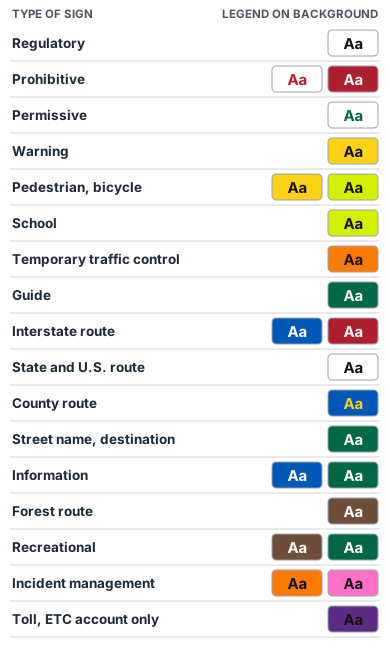
Table 2A-2 shows the common legend and background combinations for each type of sign (MUTCD). Laid out this way, a pattern shows: the background tends to carry the category, and the legend contrasts with it. Warning signs are black on yellow. School signs are black on fluorescent yellow-green. Temporary traffic control signs are black on orange. Guide signs are white on green, interstate route signs are white on blue or red, and county route signs are yellow on blue (MUTCD).
The manual calls the table a general overview of common combinations, and it says signs with standardized designs shall not have their colors modified (MUTCD). It also notes that some combinations are for use only on specific signs: for prohibitive signs, a white legend on a red background is allowed only as identified for specific signs (MUTCD). In practice, you can trust the color on a real sign, but a familiar color alone does not make a sign standard.
How do you read a sign you have not seen before?
- Look at the color. Color is the first clue and often the earliest one: Virginia’s manual notes that from a distance you may see the color long before you can read the message or see the symbol (Virginia Driver’s Manual). Yellow or fluorescent yellow-green means warning, orange means a work zone, green means direction guidance and blue means services (MUTCD).
- Check the shape. If it is an octagon, a downward triangle, a circle, a pennant or a crossbuck, the shape already names the sign (MUTCD). If it is a diamond, it is a warning. If it is a rectangle, use the color and the direction of the rectangle to decide whether it is a rule, a warning or guidance (MUTCD) (Virginia Driver’s Manual).
- Read the message or symbol last. By then you know whether to expect a rule, a hazard or directions, so the legend only has to confirm it.
Practice makes this automatic. Browse the full Road signs: every sign with its name and meaning set, then try the practice tests. For a state with its own sign score, such as Virginia, the Virginia permit test guide and the Virginia practice test: ten questions with explanations show what the exam looks like.
Where do shapes and colors show up on the permit test?
Knowing the shape and color rules lets you narrow an unfamiliar sign down to a category first. Some states also score the sign questions separately from the rest of the exam, so a weak sign score can fail you even when your rules score is strong. Which states do this, and with what minimum, is in Do you have to get every road sign question right on the permit test?. Each state’s test format is in the Questions and pass mark by state, with sources, and the other guides are in All permit test guides.
The bottom line
The MUTCD, 11th Edition with Revision 1, sets sign shapes in Table 2A-1, shows the common color combinations in Table 2A-2 and gives most colors a general meaning in Section 1D.05 (MUTCD). Learn the five shapes reserved for one sign first, then use color to sort the diamonds and rectangles into warning, regulation and guidance (MUTCD). Every sign shown here is on our Road signs: every sign with its name and meaning pages.
Related guides
Keep going
- Regulatory signs
- Warning signs
- School signs
- Work zone signs
- Railroad signs
- Road signs: every sign with its name and meaning
- Questions and pass mark by state, with sources
- All permit test guides
Practice for your state in the app
Permito has a question set for every state and Washington, D.C., mock exams, a road sign trainer and an explanation for every answer. It is free to start and needs no account.
Sources
- Federal Highway Administration (FHWA): Manual on Uniform Traffic Control Devices: Sections 1D.05, 2A.05 (Table 2A-1), 2A.06 (Table 2A-2), 2B.02, 2C.02, 2D.02 and 2J.03 (11th Edition (December 2023) including Revision 1 dated December 2025, effective March 5, 2026).
- Federal Highway Administration (FHWA): Manual on Uniform Traffic Control Devices for Streets and Highways (web page, read November 12, 2026).
- Federal Register (Federal Highway Administration final rule): National Standards for Traffic Control Devices; the Manual on Uniform Traffic Control Devices for Streets and Highways; Revision 1 of the 11th Edition (published March 5, 2026).
- Electronic Code of Federal Regulations: 23 CFR 655.603, Standards (current text, read November 12, 2026).
- Virginia Department of Motor Vehicles: Virginia Driver’s Manual, Section 2: Signals, Signs and Pavement Markings (English PDF (document title: April 2026), read November 12, 2026).
Update history
- : Published. Sources: the MUTCD 11th Edition with Revision 1, the FHWA page, the Federal Register rule, 23 CFR 655.603 and the Virginia Driver’s Manual.
Rules change. Check your state’s official handbook before your test. Permito is a private study app, not affiliated with any DMV or government agency. Found a mistake? Write to support@permito.app and we will check it against the source. How we check facts.